
New website, same high quality peptides
Express postage on all orders
New website, same high quality peptides
Express postage on all orders
New website, same high quality peptides
New website, same high quality peptides
Express postage on all orders
New website, same high quality peptides
Express postage on all orders
New website, same high quality peptides

The Australian peptide research landscape has shifted noticeably over the past twelve months. New compounds have entered the mainstream conversation, established peptides have accumulated deeper evidence bases, and the regulatory environment has continued to evolve. As of April 2026, Australian search volumes for peptides are at an all-time high — and the questions people are asking are getting more sophisticated.
This guide brings together the most searched and most researched peptides across all major categories as of April 2026, with a focus on what the evidence actually supports.
The GLP-1 receptor agonist category accounts for the majority of all peptide-related search traffic in Australia as of April 2026, driven by semaglutide, tirzepatide, and the rapidly rising retatrutide.
Semaglutide remains the most widely recognised compound in this class, with TGA-approved pharmaceutical versions available via prescription for eligible patients. Clinical trials have shown consistent average weight loss of around 15% of body weight. Its cardiovascular outcome data — published through the SELECT trial — continues to be one of the most significant findings in obesity medicine in recent years.
Tirzepatide has closed the gap considerably. Its dual GLP-1 and GIP mechanism produces greater average weight loss in trials — approximately 21% at the highest studied dose — and as of April 2026 it has progressed through Australian regulatory assessment. PBS listing discussions for weight management indications are ongoing.
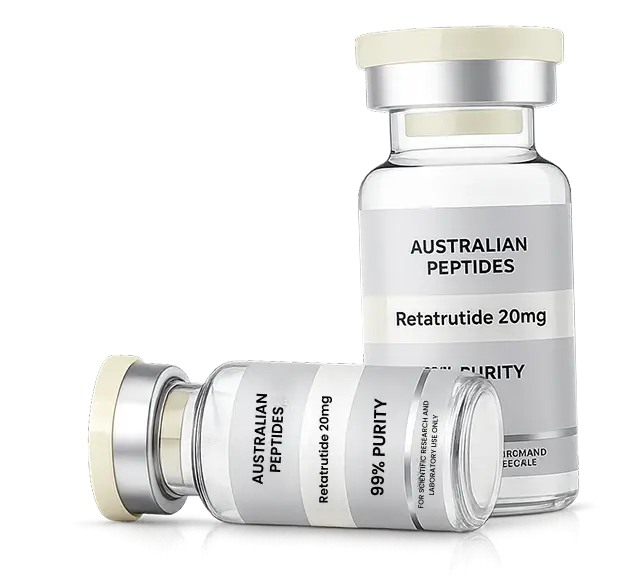
Retatrutide is the compound generating the most forward-looking interest in April 2026. Phase 2 data showing average weight loss approaching 24% over 48 weeks has positioned it as the likely next major entry in this class, though it remains an investigational compound with no current regulatory approval.
Despite the weight loss category’s dominance in raw search volume, BPC-157 remains the most searched recovery peptide in Australia and the most searched non-weight-loss peptide globally as of April 2026.
Its research base has continued to grow, now exceeding 200 published papers. The emerging gut-brain axis research direction has expanded interest beyond the fitness and sports recovery community into broader neuroscience and gastroenterology circles. That said, the fundamental limitation remains: no published human clinical trials as of April 2026.
TB-500, typically studied alongside BPC-157 as the ‘wolverine stack’, continues to attract research interest for musculoskeletal and cardiovascular tissue repair. The complementary mechanisms of the two compounds — BPC-157 modulating the local healing environment, TB-500 supporting cell migration via actin regulation — make them a logical pairing for tissue repair research protocols.
AOD-9604, Australia’s homegrown peptide fragment developed at Monash University, also maintains a steady search presence in 2026, particularly among researchers interested in fat metabolism and metabolic peptide research.
The anti-ageing category has seen the most dramatic growth in Australian search interest heading into 2026. GHK-Cu — copper tripeptide-1 — has recorded over 1,000% year-on-year growth in Australian searches, a figure that reflects genuine scientific momentum rather than pure trend-chasing.
The dermatological evidence base for topical GHK-Cu is the strongest of any cosmetic peptide in April 2026, with multiple randomised controlled trials supporting its effects on skin elasticity, collagen synthesis, and wound healing. The emerging hair biology and gene expression research has added further dimensions to what was already a well-supported compound.
Epitalon continues to attract interest from longevity researchers focused on telomere biology, though its evidence base remains concentrated in the output of a single Russian research group. Independent large-scale replication is still lacking as of April 2026, and it should be approached with that caveat clearly in mind.
NAD+ sits at the intersection of the peptide and longevity supplement worlds. As of April 2026, Australian longevity clinics have substantially expanded IV NAD+ offerings, and research into NAD+ precursors and direct administration continues to accelerate globally. The cellular energy and DNA repair mechanisms are well-established — the clinical translation for healthy ageing remains an active area.
A few developments are worth noting for researchers assessing the current Australian landscape as of April 2026.
The semaglutide supply shortage that caused significant disruption through 2024 has largely resolved, with availability through legitimate prescription channels substantially improved. This has reduced the grey-market pressure that was driving some buyers toward unregulated online sources.
TGA enforcement activity around misleading marketing of research peptides has increased. Several operators marketing research-only compounds with explicit health or performance claims have received warning letters or had products removed from sale. The regulatory distinction between research-grade products and therapeutic goods is being applied more actively than in previous years.
Domestic Australian suppliers have proliferated — as of April 2026, there are more options than at any previous point. This increases the importance of quality verification: HPLC certificates, mass spectrometry reports, GMP-accredited source laboratories, and batch-specific documentation are the minimum standard any researcher should require.
The fundamentals of responsible sourcing have not changed, but the context has. With more suppliers, more compounds, and a more active regulatory environment, the standard for due diligence is higher than it was twelve months ago.
The checklist that matters in April 2026: independent third-party HPLC testing with batch-specific purity data; mass spectrometry confirmation of molecular identity; source laboratories with verifiable GMP accreditation; domestic Australian warehousing with cold-chain shipping; clear compliance with Australian Consumer Law; and no therapeutic claims for research-only products.
At Australian Peptides, we supply research-grade compounds across all categories covered in this guide — GLP-1 peptides, tissue repair compounds, and anti-ageing peptides — with full analytical documentation, same-day dispatch from our Australian warehouse, and cold-chain packaging on all heat-sensitive products. Every batch is independently tested before dispatch.
The peptide research landscape in Australia is more active, more diverse, and more scrutinised than at any previous point. The weight loss category continues to grow, anchored by a GLP-1 class with genuinely strong clinical evidence. Recovery peptides maintain deep and loyal research interest despite the continued absence of human trials. Anti-ageing compounds — GHK-Cu in particular — have earned mainstream attention on the back of real science.
The thread connecting all of these is quality. In a market that is growing fast and attracting new operators, the researchers and practitioners who achieve the best outcomes are the ones who treat peptide sourcing with the same rigour they bring to their research design.


Need more information about Australian Peptides? Get in contact with us via the email below and Australian Peptides will assist you promptly.
Include your name and a relevant subject line.
Subscribe now to keep reading and get access to the full archive.