
Holiday Period: 17th June – 31st July
Prepare for this and stock up now!
Holiday Period: 17th June – 31st July
Prepare for this and stock up now!
Holiday Period: 17th June – 31st July
Prepare for this and stock up now!
Holiday Period: 17th June – 31st July
Prepare for this and stock up now!
Holiday Period: 17th June – 31st July
Prepare for this and stock up now!

If you’ve been following the peptide weight loss space in Australia, you’ll know that semaglutide and tirzepatide dominated the conversation for the past two years. But as of April 2026, a new compound has moved firmly into the spotlight: retatrutide.
Search volume for retatrutide in Australia has grown faster than any other weight loss peptide over the past six months. This guide breaks down what it is, what the research shows, and how it differs from the GLP-1 compounds that came before it.
To understand why retatrutide is generating so much interest, it helps to trace the progression of GLP-1 research over the past decade.
Semaglutide — marketed pharmaceutically as Ozempic and Wegovy — was the compound that put peptide weight loss on the mainstream map. As a single GLP-1 receptor agonist, it produces sustained appetite suppression by mimicking the gut hormone that signals fullness to the brain. Clinical trials showed average weight loss of around 15% of body weight over approximately 68 weeks.
Tirzepatide came next, adding a second mechanism by targeting GIP receptors alongside GLP-1. The dual action produced stronger results in trials — some participants losing up to 22% of body weight — and it quickly became one of the most searched peptides in Australia through late 2025 and into 2026.
Retatrutide represents the third generation: a triple agonist targeting GLP-1, GIP, and glucagon receptors simultaneously.
The addition of glucagon receptor agonism is what sets retatrutide apart. Glucagon is a hormone that, among other functions, stimulates the liver to burn fat for energy. By activating all three receptors, retatrutide addresses weight loss through three distinct but complementary pathways: appetite suppression, improved insulin response, and enhanced fat oxidation.
Phase 2 clinical trial data published in 2023 reported that participants receiving retatrutide achieved average weight reductions of around 24% over 48 weeks — the highest figures seen in any GLP-1 class trial at that point. Some participants in higher dose groups lost close to a third of their body weight over the trial period.
As of April 2026, Phase 3 trials are ongoing. Retatrutide does not yet have regulatory approval in Australia or most other jurisdictions, and is not available as a prescription medicine. It remains a research compound at this stage of its development.
The Australian medical and research community has been paying close attention to the GLP-1 class since semaglutide’s rise. As of April 2026, the TGA continues to regulate all GLP-1 receptor agonists as Schedule 4 prescription medicines. Retatrutide, as an unapproved investigational compound, occupies a separate category — it cannot be legally prescribed in Australia and is available only for research purposes.
Several Australian research institutions are watching Phase 3 trial outcomes closely, with interest in both the metabolic and cardiovascular data that larger trials will produce. The cardiovascular signal in earlier GLP-1 trials has been one of the most clinically significant findings, and researchers are keen to see whether retatrutide’s triple mechanism produces similar or stronger cardioprotective effects.
In terms of raw weight loss outcomes in trials, retatrutide currently sits ahead of both semaglutide and tirzepatide. However, direct head-to-head trials comparing all three compounds have not yet been published as of April 2026. The Phase 2 data for retatrutide was conducted in a specific patient population under controlled conditions, and extrapolating direct comparisons requires caution.
What the research does suggest is that the incremental benefit of adding additional receptor targets appears to be meaningful — each generation of compound has produced meaningfully stronger outcomes than its predecessor in clinical trials.
The side effect profile of retatrutide in Phase 2 trials was broadly consistent with the GLP-1 class: nausea, vomiting, diarrhoea, and decreased appetite were the most commonly reported adverse events, particularly during dose escalation. The glucagon agonism component raised some early questions about potential effects on blood glucose in specific populations, which ongoing trials are designed to assess.
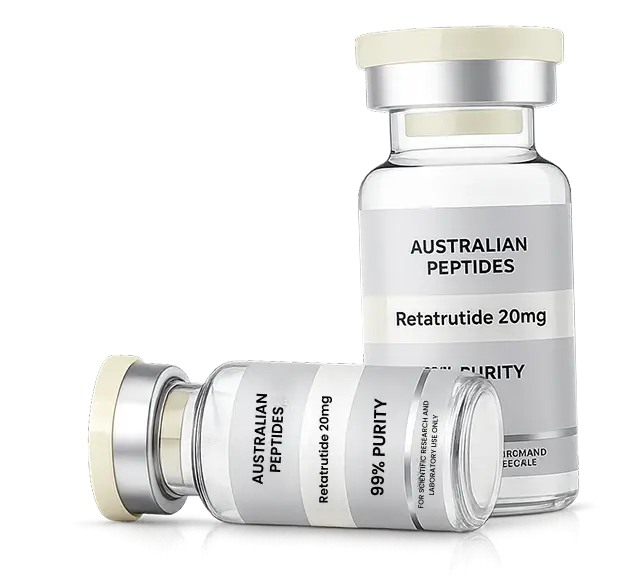
For researchers working with this compound, purity and accurate concentration data are especially critical given the dose-dependent nature of its effects. Australian Peptides provides full independent HPLC and mass spectrometry documentation with every batch, sourced from GMP-accredited international laboratories.
Retatrutide is the most promising weight loss peptide in the research pipeline as of April 2026. The Phase 2 data is compelling, Phase 3 is underway, and Australian search interest continues to climb. It is not yet an approved medicine anywhere in the world, and anyone exploring it should do so only through legitimate research channels or by consulting an Australian medical professional about emerging treatment pathways.


Need more information about Australian Peptides? Get in contact with us via the email below and Australian Peptides will assist you promptly.
Include your name and a relevant subject line.
Subscribe now to keep reading and get access to the full archive.