
Holiday Period: 17th June – 31st July
Prepare for this and stock up now!
Holiday Period: 17th June – 31st July
Prepare for this and stock up now!
Holiday Period: 17th June – 31st July
Prepare for this and stock up now!
Holiday Period: 17th June – 31st July
Prepare for this and stock up now!
Holiday Period: 17th June – 31st July
Prepare for this and stock up now!

If you are new to peptide research — or new to sourcing research peptides in Australia — this guide covers the fundamentals. What peptides are, how they are classified, why they have become such a significant focus of modern research, and what to know before you start sourcing.
What Is a Peptide?
A peptide is a short chain of amino acids linked together by peptide bonds. Amino acids are the building blocks of proteins — when a small number of them are joined in sequence, the result is a peptide. When the chain grows longer, it becomes a polypeptide, and at greater lengths still, a protein.
The distinction between peptides and proteins is primarily one of size, though there is no universally fixed boundary. In research contexts, peptides are generally understood to be chains of fewer than 50 amino acids. Many of the research compounds attracting significant scientific interest — including most of the compounds available at Australian Peptides — fall well within this range.
How Do Peptides Work?
Peptides function primarily as signalling molecules. In biological systems, they interact with specific receptors on cell surfaces, triggering downstream responses that influence cellular behaviour. The specificity of peptide-receptor interactions is what makes peptides such valuable research tools — a given peptide will typically interact with a defined set of receptors, allowing researchers to investigate specific pathways in a relatively targeted way.
This receptor specificity also explains why different peptides have such different research profiles. BPC-157 and retatrutide, for example, are both peptides — but they interact with entirely different receptor systems and are studied in entirely different biological contexts.
Natural vs Synthetic Peptides
Many research peptides are synthetic analogues of naturally occurring compounds. The body produces thousands of peptides naturally — hormones, neurotransmitters, growth factors, and immune system regulators are all examples of endogenous peptides.
Synthetic research peptides are designed to replicate, modify, or extend the activity of their natural counterparts. Some, like TB-500, are analogues of specific active regions of naturally occurring proteins. Others, like retatrutide, are purpose-designed compounds that engage natural receptor systems in ways that no single endogenous peptide does.
Why Are Peptides a Focus of Modern Research?
Several characteristics make peptides particularly valuable as research tools:
Receptor specificity — peptides tend to interact with defined receptor targets, making them useful for investigating specific biological pathways without broadly disrupting unrelated systems.
Structural diversity — the enormous variety of possible amino acid sequences means the peptide chemical space is vast. Researchers can investigate a wide range of biological questions using compounds with meaningfully different structures and mechanisms.
Relevance to endogenous systems — because many research peptides are analogues of naturally occurring compounds, they allow researchers to investigate biological processes that are directly relevant to human and animal physiology.
Tractability — peptides can be synthesised with relatively high precision and characterised in detail, which supports rigorous research methodology.
Common Research Peptide Categories
For researchers new to the field, it helps to understand the broad categories that research peptides tend to fall into:
Metabolic peptides — compounds that interact with receptors involved in glucose regulation, appetite, insulin signalling, and energy metabolism. This category includes GLP-1 receptor agonists like semaglutide, dual agonists like tirzepatide, and triple agonists like retatrutide.
Tissue and repair peptides — compounds with research profiles centred on tissue repair, wound healing, and cellular regeneration contexts. BPC-157, TB-500, and GHK-Cu all fall broadly into this category, though their specific mechanisms differ considerably.
Growth hormone axis peptides — compounds that interact with the growth hormone secretagogue receptor or growth hormone-releasing hormone receptor. Ipamorelin and CJC-1295 are examples commonly researched in this context.
Fragment peptides — synthetic fragments of larger naturally occurring proteins, designed to isolate and investigate the activity of specific regions. AOD-9604, a fragment of human growth hormone, is an example.
Getting Started With Peptide Research in Australia
For researchers beginning to source peptides in Australia, the key practical considerations are compound quality, supplier reliability, and cold-chain integrity in transit. These are covered in more detail in our sourcing guide elsewhere on this blog.
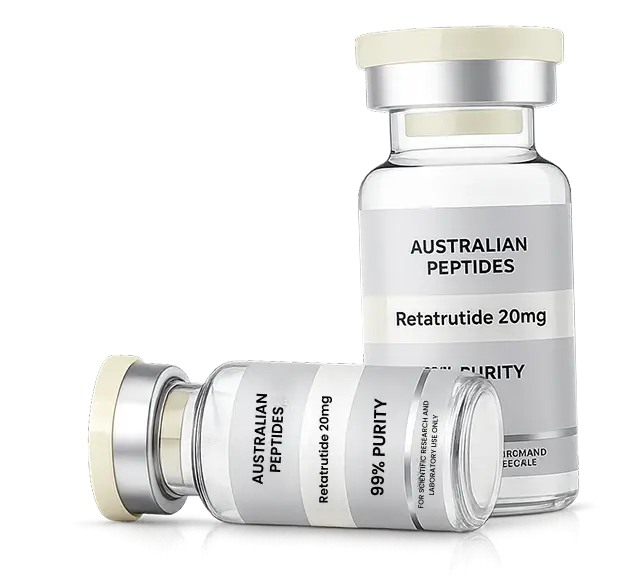
Australian Peptides stocks a broad range of research-grade peptides domestically, with 24-hour dispatch and batch documentation available on request. Current in-stock compounds include retatrutide, semaglutide, tirzepatide, BPC-157, GHK-Cu, TB-500, AOD-9604, and Ipamorelin/CJC-1295 blends.
Shop the full catalogue at australianpeptides.com.


Need more information about Australian Peptides? Get in contact with us via the email below and Australian Peptides will assist you promptly.
Include your name and a relevant subject line.
Subscribe now to keep reading and get access to the full archive.